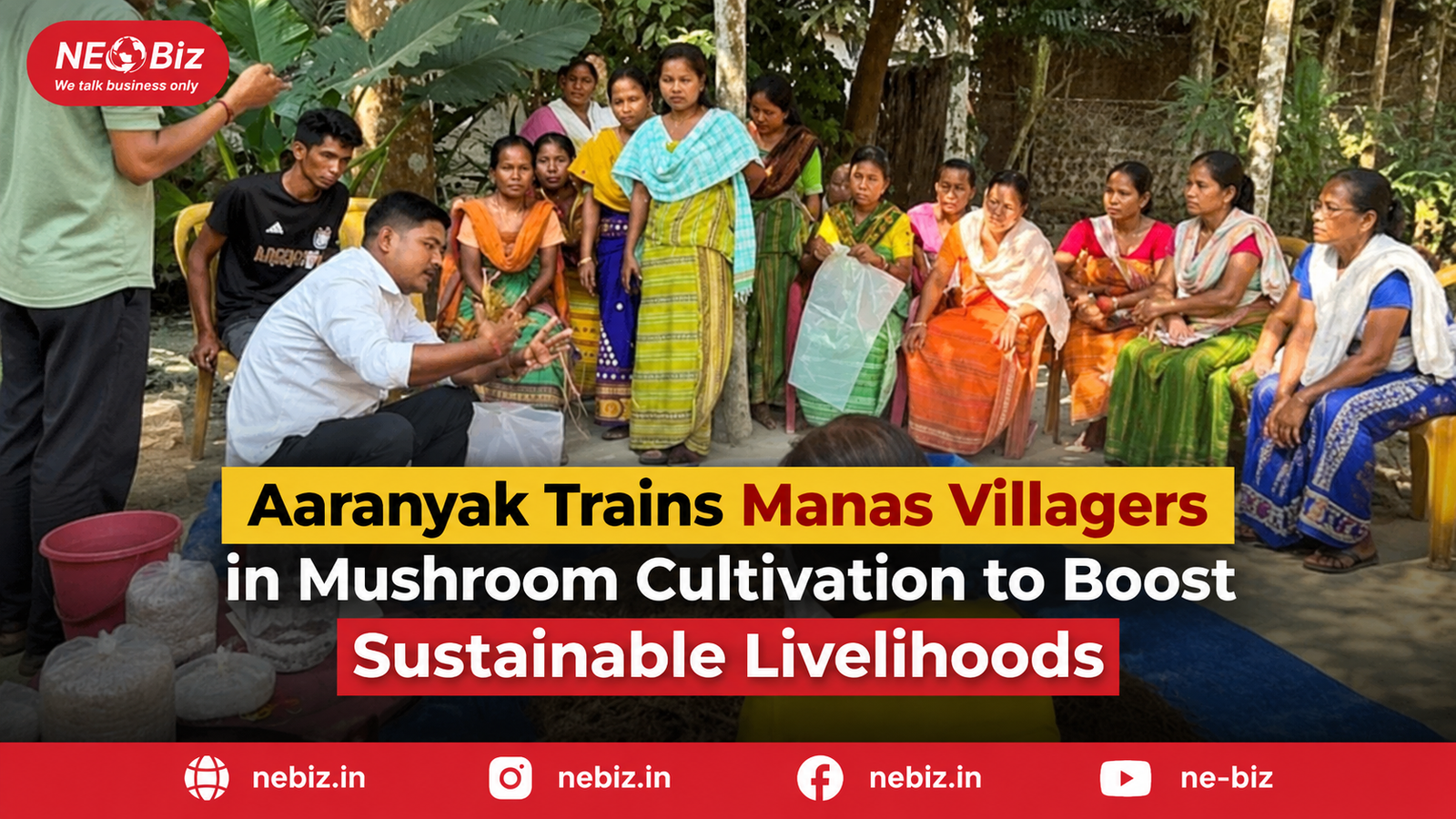
Biodiversity conservation organisation Aaranyak has conducted a practical training programme on mushroom cultivation for communities living along the fringes of Manas National Park in Assam’s Baksa district, with the aim of promoting sustainable livelihood opportunities and creating alternative sources of income for local residents.
The training programme was held on November 6 at Madanguri village in the Bhuyanpara area, bringing together 23 participants, including women from villages surrounding the national park. The initiative focused on equipping villagers with the practical knowledge and technical skills required to take up mushroom farming as a potential income-generating activity.
Led by progressive mushroom farmer Pandab Basumatary from Chirang, the programme introduced participants to different varieties of oyster mushrooms and their commercial prospects. The sessions combined technical guidance with hands-on demonstrations, allowing participants to understand the cultivation process and the essential steps involved in mushroom production.
The training covered the preparation and selection of raw materials, mixing mushroom spawn, cylinder preparation, storage and farm maintenance. Participants were also familiarised with the environmental conditions necessary for successful cultivation, including maintaining suitable moisture levels, temperature, humidity and ventilation to ensure healthy mushroom growth and better yields.
The programme received a positive response from villagers interested in exploring mushroom cultivation as a livelihood option. Radha Brahma of Madanguri village said the practical knowledge gained during the training would help her take up cultivation as an additional source of income. Similarly, Akin Boro and Sanin Boro from Karebari village expressed interest in applying the techniques learned during the programme to develop mushroom farming into a commercial activity.
The initiative was led by Detsung Basumatary and coordinated by Momita Narzary, Daimalu Basumatary and Pankaj Das, with logistical assistance from Aaranyak’s Manas Conservation and Outreach Centre (MCOC). Dr M. Firoz Ahmed, Director and Head of Aaranyak’s Tiger Research and Conservation Division, facilitated the initiative as part of the organisation’s efforts to create livelihood opportunities for communities residing near Manas National Park.
The programme was organised under the IUCN-KfW-supported project titled “Securing Population of Tigers, Habitats and Biological Corridors in Assam, India,” which focuses on strengthening tiger conservation, habitat protection and biological corridors.
The initiative highlights the importance of linking community livelihood development with biodiversity conservation. By encouraging villagers to explore income-generating activities such as mushroom cultivation, the programme seeks to support local economic opportunities while contributing to conservation efforts in the Manas landscape.
Mushroom farming offers communities the opportunity to develop small-scale cultivation activities that can potentially generate supplementary income. With practical training and improved cultivation knowledge, participants can explore the commercial prospects of mushroom production and apply the techniques within their villages.
Aaranyak’s initiative in Manas reflects the broader importance of skill development and community participation in sustainable livelihood programmes. By building local capacity and encouraging alternative income opportunities, the organisation aims to support the well-being of communities living near the national park while advancing efforts to protect the region’s biodiversity.
The training programme in Madanguri marks another step towards promoting livelihood options that connect rural development with environmental conservation in Assam’s Manas landscape.