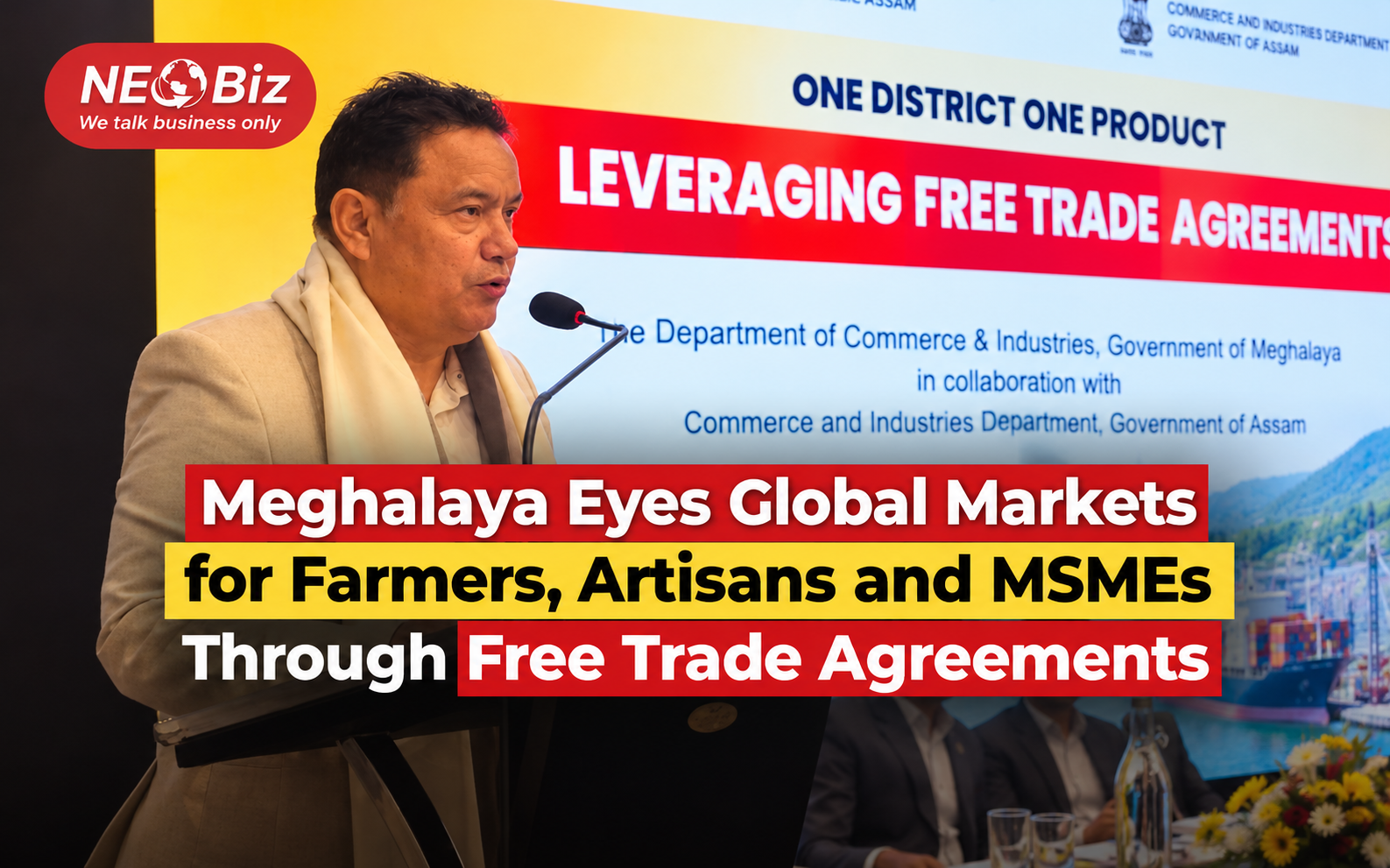
Meghalaya is looking to leverage India's growing network of Free Trade Agreements (FTAs) to expand international market access for its agricultural products, traditional handicrafts and locally manufactured goods. The state government is focusing on strengthening export readiness, improving trade infrastructure and connecting farmers, artisans, entrepreneurs and Micro, Small and Medium Enterprises (MSMEs) with international buyers. The initiative aims to position Meghalaya's indigenous products in global markets while creating new opportunities for local enterprises to participate in international trade.
The issue was discussed during a state-level outreach programme organised in Shillong on October 29, 2026, by the Union Department of Commerce in collaboration with the Meghalaya Commerce and Industries Department and the Directorate General of Foreign Trade (DGFT). Deputy Chief Minister and Commerce and Industries Minister Sniawbhalang Dhar highlighted the importance of ensuring that farmers, artisans, entrepreneurs and young people benefit from the opportunities emerging through India's trade agreements with various countries.
Dhar identified several products from Meghalaya that hold potential in international markets, including horticultural produce, spices, ginger, turmeric, pineapple, honey, bamboo products, handloom textiles and handicrafts. These products represent important components of the state's agricultural and traditional manufacturing sectors. Expanding their presence in overseas markets could provide local producers with opportunities to diversify their customer base, improve market reach and generate additional income.
India's Free Trade Agreements with international partners are expected to create opportunities for businesses by improving market access and providing preferential trade conditions for eligible products. Dhar highlighted agreements with countries and economic partners including the United Arab Emirates, Australia, the United Kingdom, Oman, the European Union and New Zealand.
According to the figures cited at the programme, these markets collectively represent a gross domestic product of approximately USD 26.8 trillion and goods imports worth around USD 8.2 trillion. For Meghalaya, accessing these markets could provide an opportunity to expand exports beyond traditional domestic destinations and introduce locally produced goods to a wider international customer base.
However, taking advantage of these agreements will require local enterprises to understand export regulations, product standards, documentation requirements and international market conditions. The Deputy Chief Minister urged businesses to obtain valid Importer Exporter Code (IEC) and Udyam registrations and familiarise themselves with the procedures required to access export promotion schemes.
The Centre's Export Promotion Mission is another important component of the effort to strengthen India's export ecosystem. Approved in November 2025 with an allocation of ₹25,060 crore until 2030-31, the mission is designed to support businesses through financial and non-financial assistance.
Its two components, Niryat Protsahan and Niryat Disha, are intended to address different requirements of exporters. While Niryat Protsahan focuses on trade finance and financial support, Niryat Disha provides non-financial assistance, including support for market access and export development.
Other support measures include transportation assistance under the LIFT scheme, participation in international trade fairs and opportunities to connect with overseas buyers through buyer-seller meetings. These initiatives are particularly relevant for smaller businesses that may face financial, logistical and administrative challenges when entering international markets.
For Meghalaya's MSMEs, access to such support could help address some of the difficulties associated with exporting products, including transportation costs, market identification, compliance requirements and establishing international business connections.
Highlighting the state's efforts to establish direct connections between local producers and overseas markets, Dhar referred to the Reverse Buyer Seller Meet 2.0, held on October 8 and 9, 2026.
The event brought together 30 international buyers from 16 countries, two domestic buyers and approximately 400 sellers and MSMEs representing all 12 districts of Meghalaya. More than 100 memoranda of understanding (MoUs) were signed during the programme, with business orders under negotiation.
The participation of international buyers provided local enterprises with an opportunity to showcase their products, understand buyer requirements and explore potential commercial partnerships. Such platforms can play an important role in connecting small producers with international supply chains and helping businesses identify new markets for their products.
The participation of enterprises from all 12 districts also highlights the government's effort to broaden export opportunities beyond established commercial centres and encourage wider participation in the state's export economy.
Meghalaya's geographical position along the India-Bangladesh border provides an additional advantage for strengthening regional trade. The state government highlighted the importance of the Dawki-Tamabil Integrated Check Post and existing Land Customs Stations in facilitating cross-border commercial activity.
The government has proposed establishing a new Land Customs Station at Umkiang in East Jaintia Hills. It has also called for upgrading facilities at Bagli, Borsora, Bholaganj, Mahendraganj and Dalu into Integrated Check Posts.
In addition, Dhar urged the Centre to facilitate the reopening of five existing border haats along the India-Bangladesh border and operationalise the completed border haat at Huroi in East Jaintia Hills.
These proposed improvements are aimed at strengthening trade infrastructure, facilitating the movement of goods and creating more opportunities for local producers and traders to participate in cross-border commerce. Improved border facilities could also help strengthen economic connections between communities on both sides of the international boundary.
Joint Secretary in the Union Department of Commerce Kapil Chaudhary highlighted that India had signed around seven Free Trade Agreements in the preceding five years, providing access to markets accounting for more than 75 per cent of global GDP.
She emphasised that Meghalaya would need to identify products with export potential, improve export mapping and strengthen international logistics to translate the opportunities offered by trade agreements into measurable economic gains.
The state's exports are estimated at approximately USD 77 million. Chaudhary called for stronger trade linkages and efforts to capture shipments that are currently routed through ports outside Meghalaya.
She also highlighted 11 intervention areas under the Export Promotion Mission, including market access initiatives, transportation assistance, market intelligence and overseas warehousing. Businesses were encouraged to make use of the available support to overcome logistical barriers and improve their competitiveness in international markets.
Commissioner and Secretary of the Meghalaya Commerce and Industries Department Cyril V. D. Diengdoh stressed that trade agreements would produce meaningful results only when local producers were adequately prepared to access the opportunities available to them. He underlined the importance of coordination among Central ministries, state and district administrations, financial institutions, export promotion councils and Indian missions abroad.
The outreach programme included sessions covering Meghalaya's export potential, FTA provisions, export finance, trade compliance, logistics, the Export Promotion Mission, the Districts as Export Hubs initiative and the Trade E-connect portal. Separate discussions with relevant agencies also addressed testing, certification and compliance requirements, which can often pose challenges for small businesses seeking to enter international markets.
The state's efforts to expand international trade reflect a broader approach towards strengthening local industries, promoting indigenous products and creating new economic opportunities for rural and small-scale enterprises. Agriculture, horticulture, food processing, handloom, handicrafts and bamboo-based industries are among the sectors that could benefit from improved access to overseas markets.
For farmers and agricultural producers, stronger export connections could open up opportunities to reach buyers beyond domestic markets. Artisans and traditional craft producers could explore new commercial channels for handloom, handicrafts and bamboo products, while MSMEs could use international trade platforms to expand their customer base and establish long-term business relationships.
However, achieving sustained export growth will depend on several factors, including consistent product quality, adequate production capacity, reliable transportation, international certification and compliance with destination-market requirements. Strengthening these areas will be important for enabling smaller enterprises to compete in international markets.
Dhar said the outcomes of the outreach programme should be translated into a state action plan, followed by district-level workshops aimed at delivering tangible export growth. The approach is intended to ensure that information about export opportunities and government support reaches businesses and producers across Meghalaya.
As Meghalaya works towards expanding its presence in international trade, the effective use of Free Trade Agreements, export promotion schemes, buyer-seller networks and improved border infrastructure could play an important role in strengthening its regional economy. By connecting local products and enterprises with global markets, the state is seeking to create a more diversified export ecosystem that supports farmers, artisans, entrepreneurs and MSMEs.
The initiative places export-led growth at the centre of Meghalaya's economic development efforts, with the objective of transforming the state's agricultural resources, traditional skills and local manufacturing capabilities into stronger commercial opportunities.