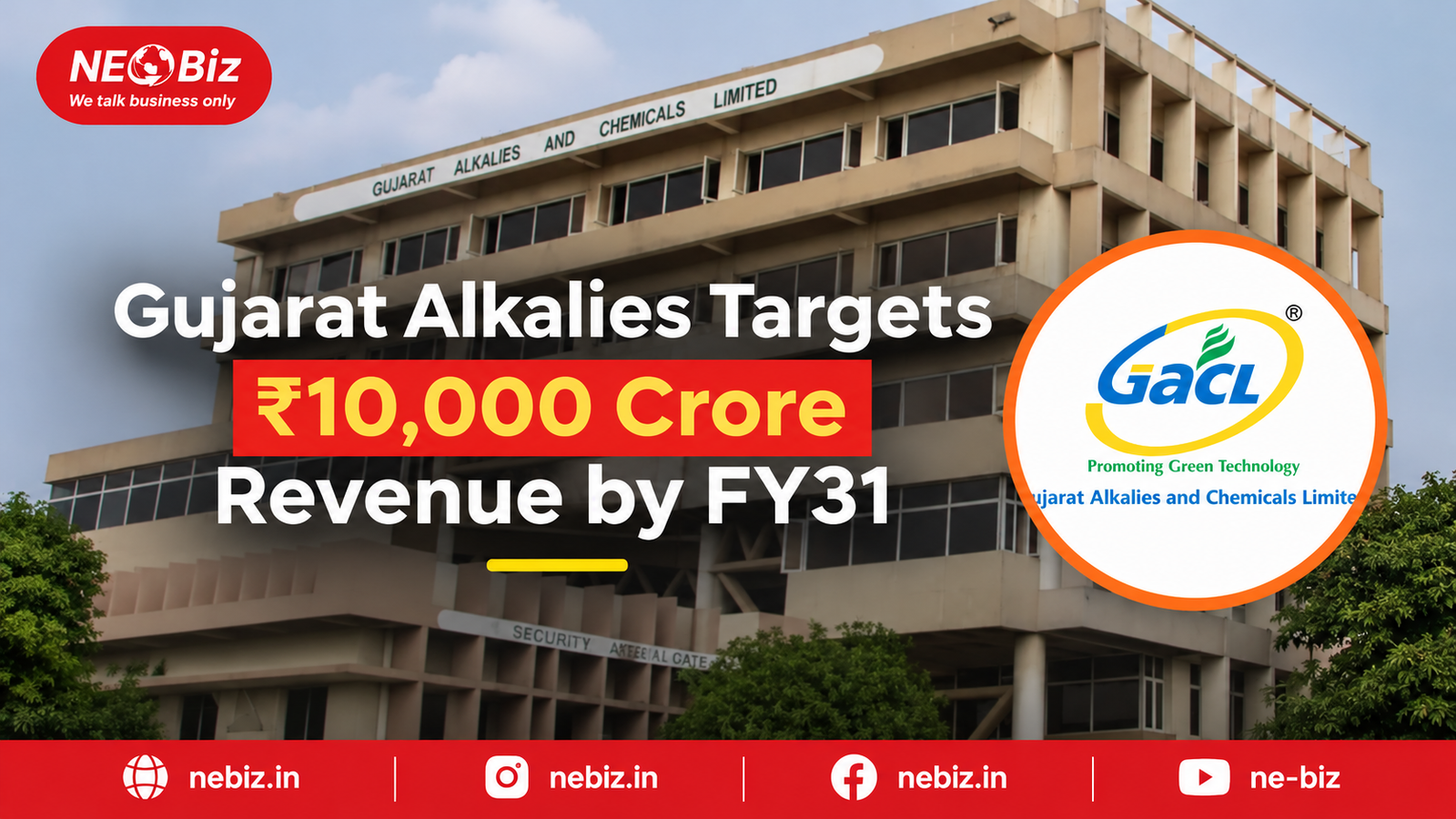
Gujarat Alkalies and Chemicals Limited (GACL) has outlined an ambitious long-term growth roadmap, targeting revenue of more than ₹10,000 crore and EBITDA margins exceeding 20% by FY31. The company's strategic transformation programme, Project Ahvaan, is aimed at strengthening operational performance, expanding its product portfolio, improving profitability and positioning the business for its next phase of industrial growth. The targets reflect GACL's ambition to scale up its operations while transitioning towards a more diversified and value-driven chemical manufacturing business.
The company's growth strategy is built around three major pillars: structural performance improvement, long-term growth and diversification, and digital transformation. Through these initiatives, GACL intends to improve productivity, optimise plant operations, enhance asset utilisation and strengthen its competitiveness in the chemical manufacturing sector. Rather than relying only on increasing production capacity, the company is increasingly focusing on improving operational efficiency, downstream integration, energy management and higher-value product development.
A key component of the roadmap is the expansion of its downstream chemical operations and specialty chemicals portfolio. GACL is working on several projects designed to strengthen its product mix, increase value addition and improve its ability to utilise key chemical inputs within its own manufacturing ecosystem. The company's strategy includes increasing downstream chlorine integration from approximately 45% currently to around 75% over the next two to three years. Greater integration is expected to help reduce exposure to fluctuations in merchant chlorine prices while supporting the production of downstream chemical products with improved value potential.
GACL is also pursuing a series of capacity expansion and modernisation projects across its manufacturing facilities. At its Dahej facility, the company is targeting the commissioning of a 200-tonne-per-day caustic soda flaking plant by December 2026, alongside cell element replacement initiatives aimed at strengthening production efficiency. A 120-tonne-per-day hydrochloric acid synthesis unit is targeted for January 2027, while Phase I of its chlorotoluene downstream projects is expected by March 2027. These projects form part of the company's near-term expansion pipeline and are intended to enhance production capabilities and strengthen its downstream portfolio.
Further projects are planned over the medium term as GACL looks to expand into specialised and higher-value chemical segments. An electronic-grade hydrogen peroxide facility is planned for 2028, while additional investments in food-grade phosphoric acid production, caustic soda revamping, potassium hydroxide expansion and other manufacturing infrastructure are expected to support its longer-term growth ambitions. These developments are aimed at broadening the company's product offerings and strengthening its presence in industries that require specialised chemical inputs.
Energy efficiency and renewable power adoption are also emerging as important priorities in GACL's business strategy. Chemical manufacturing, particularly chlor-alkali production, is energy-intensive, making electricity costs a major factor influencing operational performance and profitability. The company is therefore working to increase its renewable energy share, improve power procurement efficiency and reduce its dependence on conventional energy sources. GACL aims to raise the share of renewable energy in its overall power consumption to 60% by March 2027 and further increase it to 80% by FY30. These initiatives are expected to help reduce energy costs over time while supporting the company's sustainability objectives.
The company's renewable energy initiatives are closely linked to its broader cost optimisation strategy. By improving its energy mix, increasing operational efficiency and investing in more sustainable manufacturing practices, GACL aims to strengthen its cost competitiveness and improve margins. Renewable power integration is expected to play a particularly important role in helping the company manage energy price volatility, which remains a significant challenge for chemical manufacturers.
Project Ahvaan also places emphasis on digital transformation and structural improvements across the organisation. Digital technologies, process optimisation and better operational monitoring are expected to contribute to improved efficiency, productivity and decision-making. As the chemical industry faces increasing competition, changing market requirements and rising expectations around environmental performance, technology adoption and operational flexibility are becoming increasingly important for manufacturers seeking sustainable growth.
GACL's financial performance has also provided a foundation for its expansion plans. During the first half of FY27, the company reported revenue from operations of approximately ₹2,602 crore, compared with ₹2,188 crore in the corresponding period of the previous year. EBITDA also improved during the period, reflecting better operational performance, improved realisations and ongoing cost optimisation efforts. The company has been working to sustain this improvement through stronger production performance, disciplined capital allocation and initiatives aimed at improving asset productivity.
The ₹10,000 crore revenue target represents a significant step-up in scale for GACL and reflects its intention to build a stronger, more diversified and efficient business over the coming years. The company is seeking to balance capacity expansion with profitability, ensuring that new investments contribute to long-term value creation rather than growth in volumes alone. Its focus on specialty chemicals, downstream integration, renewable energy and operational efficiency is expected to remain central to this transformation.
However, achieving the FY31 targets will depend on several factors, including the timely completion of expansion projects, market demand, chemical price movements, energy costs, raw material availability and the company's ability to maintain operational efficiency. GACL has indicated that these targets represent a long-term aspiration rather than near-term financial guidance, underscoring the importance of execution and evolving market conditions.
With Project Ahvaan guiding its transformation, Gujarat Alkalies and Chemicals Limited is positioning itself for a broader expansion of its industrial footprint, stronger value addition and improved profitability. Its roadmap reflects a growing emphasis on diversification, sustainable energy, downstream manufacturing and efficiency-led growth as it aims to become a ₹10,000 crore-plus revenue company by FY31.